

Solana Trading Slows as Network Pushes Institutional Stablecoins
4 Min. Lesezeit
Solana is expanding its focus on institutional stablecoin payments as speculative trading loses ground. Galaxy Research figures show that meme coins accounted for just 15% to 20% of network trading volume in the second quarter of 2026, down from more than half in late 2024.
The shift comes as Solana faces declining decentralised exchange activity, reduced derivatives market share and pressure on its native cryptocurrency, SOL. Meanwhile, payments companies are introducing services that use the blockchain for dollar-denominated transfers.
Solana Trading Volumes Decline as Speculation Retreats
Galaxy Research reported that decentralised exchange trading volume declined 45% in Q2 2026, the second consecutive quarterly decline.
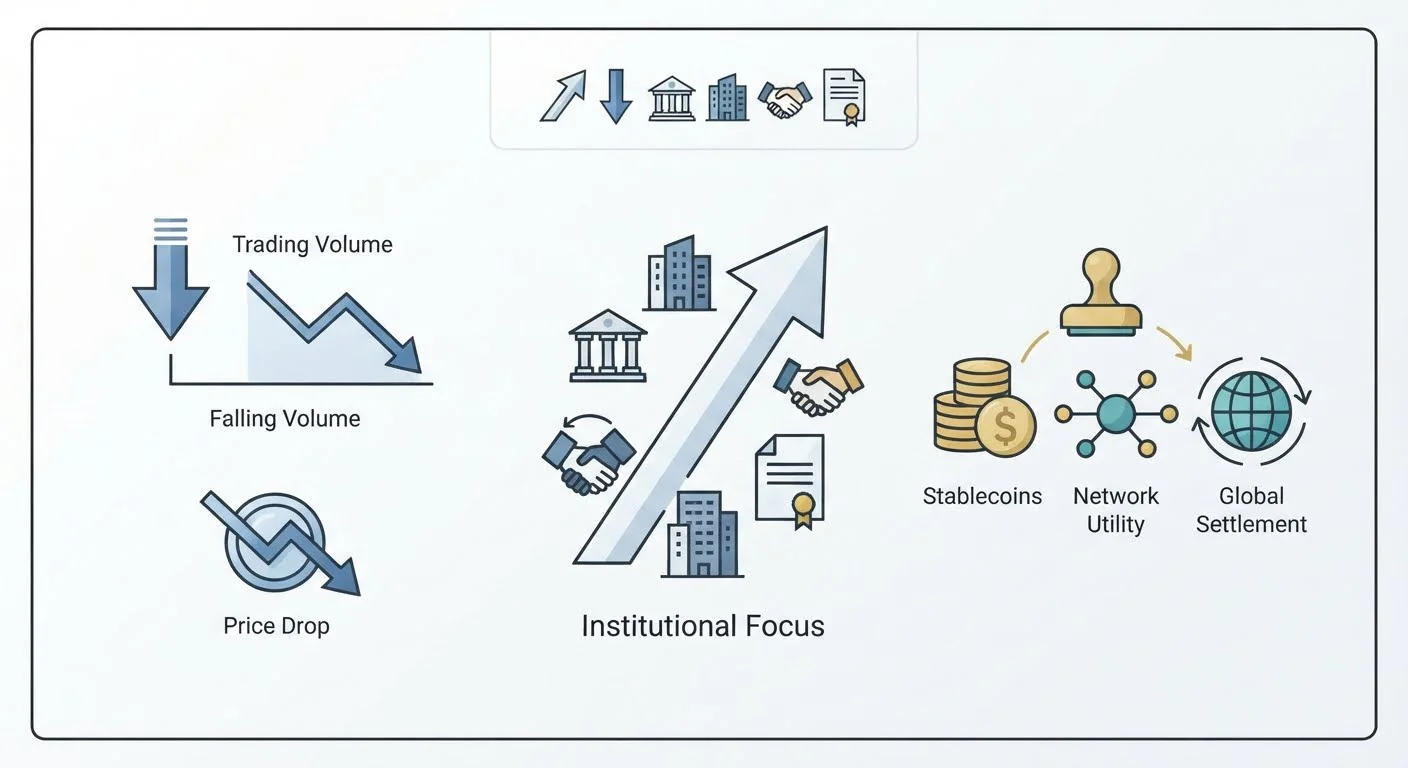
Separately, Galaxy’s analysis showed that Solana’s share of on-chain perpetual futures trading had fallen from approximately 17% to 6%, with Hyperliquid attracting competing activity.
Galaxy also found that SOL-to-stablecoin and stablecoin-to-stablecoin swaps accounted for much of the network’s trading, while tokenised stocks and wrapped assets represented approximately 10% of Q2 volume.
According to DefiLlama, Solana’s decentralised exchanges recorded approximately $1.386 billion in trading volume during the 24 hours covered by its 28 October 2026 snapshot. Seven-day volume stood at $11.70 billion, down 10.32% from the preceding week.
The same snapshot showed perpetual futures volume of $4.39 billion over seven days, down 44.86% from the preceding period. These figures measure trading activity rather than the value of stablecoins transferred between wallets.
Western Union and Samsung Expand Stablecoin Payments
Western Union launched its USDPT payment stablecoin on 4 May 2026, using Solana as the underlying blockchain and Anchorage Digital Bank as the issuer.
In its official announcement, Western Union chief executive Devin McGranahan said: “By integrating a regulated digital dollar directly into our network, we’re creating a more efficient settlement layer that supports partners, agents and future consumer use cases — all while preserving the trust and scale that define our brand.”
The May launch preceded further developments in Solana’s financial services ecosystem. Galaxy’s second-quarter research documented the changing composition of trading activity, while payment integrations and network upgrades announced in October extended the focus towards settlement services.
Samsung Electronics announced plans to introduce stablecoin transfers through Samsung Wallet during the final week of October 2026, targeting 82 million eligible Galaxy devices in the United States.
The service initially supports USDC transfers to compatible wallets and eligible bank accounts in more than 60 countries, where recipients may receive local currency. Samsung identified Solana and Sui among the technology partners supporting the service, alongside other infrastructure providers.
Stablecoin Activity Has Not Lifted SOL Prices
DefiLlama’s October snapshot placed USDC at approximately $6.72 billion on Solana, representing a substantial share of the network’s stablecoin market capitalisation.
The stablecoin figures measure assets circulating on the network, not the volume of payments actually completed. They therefore cannot establish how much institutional settlement activity has increased.
According to Bloomberg’s reporting, SOL had fallen approximately 20% year to date, while US-listed spot and staking Solana exchange-traded funds recorded around $50 million in combined net outflows over two consecutive weeks in October.
The figures illustrate continued investor pressure despite developments in institutional payments.
Low transaction costs also limit revenue generated per transfer. DefiLlama recorded approximately $39,601 in 24-hour chain revenue on 28 October, illustrating why payment adoption and network earnings must be assessed separately.
Alpenglow Upgrade Targets Faster Settlement
Solana’s Alpenglow upgrade activated on 21 October 2026, replacing TowerBFT with the Votor consensus algorithm. According to Solana’s technical documentation, the upgrade targets transaction finality of approximately 150 milliseconds, compared with 12.8 seconds under the previous system.
Faster finality is relevant to payment providers seeking shorter settlement times. It does not eliminate smart contract, counterparty or operational risks, and faster processing alone does not establish higher demand for SOL.
Galaxy Research identified recurring borrowing, collateral use and trading fees as measures of whether Solana’s expanding tokenised asset infrastructure can generate sustained economic activity. Those outcomes will provide a clearer test of the network’s financial transition than new product announcements alone.
Key Story Metrics & Analytical Comparison
| Indicator | Reported figure | Period |
|---|---|---|
| Stablecoin market capitalisation | $15.51 billion | 28 October 2026 |
| Real-world asset active AUM | $2.47 billion | 28 October 2026 |
| Chain fees | $538,017 | 24-hour snapshot |
| SOL price | Approximately $102 | 28 October 2026 |
| USDC share of stablecoins | 43.35% | 28 October 2026 |
Live-Solana-Chart
Daten: CoinGecko. Preise in USD.